
Donald Trump’s Top 100 Election-Rigging Schemes for 2026, Part VI
Introduction
The prior reports in this series are here: Part I; Part II; Part III; Part IV; and Part V.
A full introduction to the series can be found here.
This entry in the report series covers Trump election-rigging plots #58 through #70.
Donald Trump’s Top 100 Election-Rigging Schemes for 2026 (#58 Through #70)
(58) The Republican Party is now confirmed to have a plan in place to end American democracy in the first week of January 2027—with the plan depending upon eldritch bureaucratic maneuvers in Congress, and a declaration by the party that certain of its political opponents are categorically not eligible to serve in Congress.
Proof has been writing for years now that major media’s refusal to call out erroneous usages of terms like “socialist” and “Communist” by the Republican Party would end up having significant downstream effects.
While members of the Democratic Socialists of America do indeed employ the word “socialist” in the name of their organization, we must keep in mind that the far right, fascist—and anti-socialist—German Nazi Party in the 1930s and 1940s also had the word “socialist” in its name, and it certainly didn’t stop Adolf Hitler from making Communists and socialists (i.e., social democrats) among the first victims of his many concentration camps.
In other words, political groups can market themselves however they like—what really matters is their platform and agenda. Hitler’s Nazis had a platform filled with murderous contempt for every “leftist” value, including every basic precept of both democratic socialism and social democracy. And the DSA has a platform that in many respects mirrors what’s called “social democracy” in Europe… and is the ideology that governs many of the countries Donald Trump rates among the most impressive on Earth (ones which, according to the Washington Post, he wants America to emulate).
That said, it’s also the case that most “DSA” candidates don’t agree with some of the DSA platform—the same is true with many Democrats and many Republicans—and that even in its written form the platform, as with the Democratic and Republican platforms, is more ideational than literal. For instance, the DSA platform may wish to envision wholesale changes to the United States Constitution, but since it’s merely a manifesto rather than a blueprint, it needn’t get into the fact that the Constitution is changed through a painstaking “amendment” process rather any more revolutionary means. That the document doesn’t get into such details doesn’t permit outsiders to simply read into it whatever anxieties and misunderstandings they have about social democracy generally or the DSA specifically.
It appears, therefore, to be the result of corporate journalistic failures and far-right demagoguery—and more broadly, an abysmal understanding of history and semantics in certain quadrants of American political discourse—that leads the Republican Party to now believe that not only are all DSA members “Communists” (none are, or they would belong to an entirely separate entity, the American Communist Party) but their desire to see the Constitution amended is in fact a desire to see it burned to cinders without any recourse to the amendment process.
It’s easy enough to say that only a moron or demagogue would believe any of this, but the fact that corporate journalism has lately allowed such grave misstatements and misunderstandings to thrive—or other similar ones, such as a slur Republicans have used against Democrats for almost a hundred years (one that involves calling the Democratic Party the “Democrat Party” [sic] as a way of implying that all its members are undemocratic Communists)—is what’s brought us to where we currently are: the “find out” phase of American corporate media spending years “fucking around” with basic journalistic ethics.
Which brings us to the latest Trumpist election-rigging scheme—as destructive a scheme as American politics has seen since the American Civil War.
Fox News is now reporting that “a little-known congressional maneuver could block members of the Democratic Socialists of America (DSA) from being sworn in as members of the House of Representatives next year, even if they win their elections on Tuesday. [Because] members-elect must swear an oath to uphold the Constitution before they can become full members of the House….an argument circulating in conservative circles posits that any member-elect can challenge another member-elect’s right to be sworn in, provided they have compiled evidence that that person would not uphold their oath. That would then lead to House-wide deliberations followed by a vote on whether that member-elect has a right to be sworn in.”
There is, of course, no evidence that any DSA candidate would refuse to uphold the Constitution as it currently exists—even as the entire world saw the leader of the party that would be engaging in this obscene scheme violate his Oath to the Constitution on January 6, 2021. Nevertheless, such a gambit could threaten the seating of Dr. Abdul El-Sayed (D-MI) in the United States Senate if he wins election in November, even though (wait for it) he’s not a DSA member. In other words, this election-rigging scheme is simply a second Red Scare; it either treats membership in an organization as disqualifying for public service when it’s not and/or falsely places persons into groups they don’t belong to in an effort to bar them from public life. And you know who did exactly that in the 1930s and 1940s? The socialists… i.e., the National Socialist (“Nazi”) Party of Germany.
This is ugly, scary stuff. But it also fits a pattern we’re seeing across the country:
- Republicans uniquely scared about losing the Senate;
- concocting idiosyncratic, tailored plans to delegitimize and disqualify the Democratic candidate (and current poll leader) in every battleground state;
- none of which plans are legal; but which
- nevertheless touch on nearly every state in contention: Texas (where, see infra, the argument against James Talerico will rest on an Executive Order relating to DEI); Michigan (the aforementioned, addled “DSA” plot); Alaska (where, see infra, the GOP wants to invalidate the election in advance over some very standard ballot-stacking); and Georgia (where, see infra, the focus will be on allegedly hackable voting machines).
Moreover, as already discussed in this prior report, DOJ and the FBI appear ready to make this wildly illegal mass disqualification scheme a whole-of-institution effort.
(59) Donald Trump is directly trading away globe-transforming U.S. foreign policy for comparatively minor political victories that he hopes will help him and his party in the midterms—and he openly admits doing so.
Certainly, it’s wonderful news that retired American teacher Stephen Hubbard has been released from the custody of Trump’s murderous autocrat friend Vladimir Putin.
Though the New York Times notes there was “little cost” to Putin in releasing him, it somehow took Putin’s friend—the President of the United States of America—nearly two years to do it.
Why? Apparently because Putin would only do it if he were getting something in return, a classic instance of a terrorist and war criminal demanding that the U.S. government negotiate with terrorists and war criminals contrary to our longstanding policy.
Yet that seems to be exactly what Donald Trump did.
And he knew it was wrong.
Clearly Trump knew it was improper for him to tie America’s position on the Russia-Ukraine War to Russia agreeing to return a single American citizen it kidnapped many years ago, because he went to great lengths to assure American voters—both in televised pressers and in interviews—that he gave his friend Putin “nothing” in return for Hubbard.
But that was a lie.
How do we know?
Because Trump ultimately slipped and said so. And boy, did he ever say so:
“I was in the midst of getting Stephen out of Russia. And if we did what these foolish people wanted me to do [and refused to drop sanctions on Russian oil in the midst of rising diesel costs post-Iran War], he wouldn’t be coming out right now. He’d be in there for another twenty years. So, the last thing I was going to do is break up that [possibility by maintaining sanctions on Russia].”
“The past administration [the Biden administration] gave massive amounts of money and other things [to get hostages released]. You can’t do that. And when you do that, the problem [in American citizens getting kidnapped abroad] is greatly exacerbated.”
So there you have it.
Trump stopped arming our ally Ukraine with gifted material rather than arms sales, and dropped the sanctions America put on Russia for its illegal invasion of Ukraine, and ignored the policy advice that the entirety of the U.S. intelligence community and his many Ukraine experts and his many Russia experts were giving him, because otherwise he wouldn’t have gotten a tiny perk from his longtime friend and ally Putin—one that was in fact “little cost” to the Kremlin.
Which, not for nothing, is currently in a cyberwar with the United States.
So why was Mr. Hubbard worth violating America’s policies, alliances, intelligence judgments, protocols, and longstanding best diplomatic principles? Because Trump wanted a photo op he believed would help him do a smidge better in the midterms.
“I can do stuff that is unbelievable” is, if you can believe it, Trump’s closing argument in the midterms—verbatim—and apparently getting Hubbard released fit the bill, for the simple reason that the Biden administration hadn’t been able to do so in the few months between Hubbard’s 2024 show trial in Russia and the end of Biden’s sole term in office.
To add insult to injury, Trump, who had obviously traded U.S. sanctions policy in the Eastern European theater for Hubbard—given that Mr. Trump describes the deal as taking merely a one-sentence request and a several-second response, there would’ve been no reason for it not to have been consummated on January 21, 2025, Trump’s first day in office, if it weren’t connected to Trump dropping sanctions on Russian oil just before the release—the president went on at great length in lying to the American people:
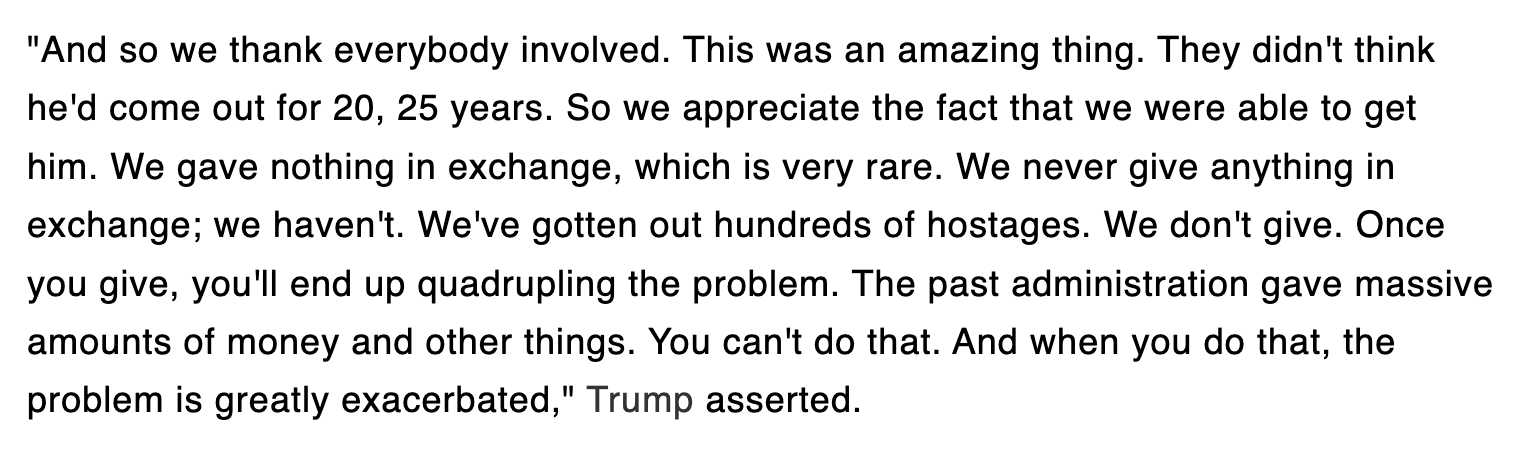
“We gave nothing in exchange….We never give anything in exchange. We haven’t….We don’t give….You can’t do that.”
All premeditated lies, and all told to (a) set up a midterms photo op for Republicans and, far more importantly, (b) encourage (see infra) continued—illegal—pro-Trump Russian election interference in the midterms.
(60) Donald Trump opposes bribery regulation, from the Foreign Corrupt Practices Act to federal bribery statutes, from the activities of anti-corruption watchdogs in America and elsewhere to the very notion that conflicts of interest exist in business or politics. This might cause one to think that Trump saving his friend, golfing buddy, and critical Senate ally Lindsey Graham from a federal criminal Bribery investigation was just a matter of Trump protecting a friend while continuing to exhibit his usual welcoming attitude toward public and private corruption. But the reality is that 2026 is an election year, holding the Senate is critical to Trump, and the late Senator Graham was up for re-election. And as we’ve seen, South Carolina is a state where any severe weakness in a GOP candidate could lead to a flip of their seat to the Democrats. So Trump having his personal lawyer Kash Patel purge the FBI to ensure a Bribery case against Graham couldn’t be made must be seen as election interference involving clandestine illicit conduct by the U.S. president.
While this notation also includes allegations of wrongdoing by a top Democrat (Rep. James Clyburn of South Carolina), that wrongdoing isn’t tied to the 2026 midterm elections—the sole subject of this report series. So it is, in fact, only the Republican involvement in this news item that can conclusively be linked to election interference.
In his 2026 primary, the then-living Graham saw over 43% of dedicated South Carolina Republicans oppose his candidacy, a number far higher than it had been in 2020 (32%).
And that’s without his potentially felonious criminal conduct being known.
We must also keep in mind here that Trump is infamously disloyal to his friends, has been spectacularly disloyal to Graham since his death—suggesting that he wouldn’t have been particularly loyal to him, or made any decisions out of loyalty to him, had Mr. Graham lived for the entirety of the 2026 midterm election cycle—and that while Trump has an extensive history of protecting Republican friends in public service from the consequences of their actions, he usually lets them suffer for a while first to play up his own largesse… so it’s pretty widely understood that in purging the FBI to save Graham early in 2026 Trump was, again, engaging in corruption for elections purposes.
Simply put, Donald Trump wants every Republican currently in office to remain there or else be replaced by another Republican, but even more importantly he’s striving to maintain the same preposterous argument he’s deployed in every election cycle he’s been involved in: Republicans are patriotic law-abiders, Democrats nihilistic goblins who hate America.
And if it takes rigging federal prosecutions to rig federal elections, he’s willing to do so.
(61) As could have been foreseen, Trump and Republican lies about the recent “ballot-stacking” situation in Alaska—that is, the presence of two “Dan Sullivan” candidates on the Senate ballot—have become so extreme and extraordinary that they themselves are now a new front in the Trumpist effort to rig the 2026 midterms.
Sound far-fetched? Well, consider this report from the New York Times.
First, the Times confirms that so-called “ballot stacking” is “generally legal” and even “common in politics.” This basic fact can therefore be presumed to be known by both Republican attorneys and Republican politicians. Yet both groups are instead now falsely claiming that ballot stacking is illegal, that Democratic Senate candidate Mary Peltola is a criminal, that she should be removed from the ballot and prevented from running for office to the same degree as an impeached and convicted President of the United States would be, should be federally criminally prosecuted, and should receive a prison sentence.
Second, all the foregoing deceitful hyperventilating presumes that Peltola knew about the ballot-stacking effort her staff was allegedly engaged in. That’s universally the assertion being made by Trump and his agents—despite the fact that the only report on the subject so far published (indeed, the very one that Trump and his agents are repeatedly citing, meaning they claim to have read it) categorically makes clear that Peltola did not participate in the effort whatsoever. This is confirmed not by a Peltola ally but a previously fired former deputy chief of staff for Peltola who has every reason in the world to detest the Alaska Democrat.
Third, Trump and his agents are likewise calling for the “second” Dan Sullivan on the ballot to be removed from it and precluded from higher office in the same way—again—an impeached and convicted President of the United States would be (keeping in mind, here, that they’re calling for this not only before any conviction for anything, but before even any prosecution and indeed before an investigation has gotten underway).
They do this, moreover, despite the fact that Sullivan insists he wasn’t recruited into the race; that Alaska courts have already repeatedly said that he’s legally on the ballot (and that it isn’t even a close call, legally speaking); and that even the New York Times report indicates that the ballot-stacking effort allegedly engaged in by Peltola’s staff was incredibly broad-based and catholic (meaning that it was in no way particularly focused on just the man named Dan Sullivan who ultimately ended up on the ballot).
Fourth, it’s clear that, behind the scenes, Trump and his agents are insisting that major media make this single allegation against a single team of staffers in a single American state the defining issue of the 2026 midterm elections despite the fact that—as the very Proof report series you’re reading now confirms—it’s positively dwarfed by Trump and his agents’ 100 minimum election-rigging plots (plots that cover not just every battleground state in the United States but virtually every American state, period). The result of this frantic Trumpist push for media coverage of the situation in Alaska is that coverage of it has become wildly irresponsible; it’s clear that major media’s profit motive in keeping its few conservative readers happy—and its equally (apparently) compelling institutional motive to keep its (often) GOP-donating owners in the good graces of the White House—is putting a finger on the scale of national coverage of this in a way that now deeply distorts an extremely close race in Alaska.
For instance, even the disgruntled former employee the Times hangs its hat on with respect to whether Peltola was involved in the ballot-stacking effort insists only that she was “aware” such an effort was happening. She makes clear that Portola wasn’t involved with it. Yet when Peltola then tells media that “knew nothing about any other candidates on the ballot”—a statement wholly consistent with the idea that she may have known staffers were looking for additional candidates, but was never made aware of any details regarding those prospective candidates, or how they were being identified—the Times falsely claims that Peltola’s account is “contradicted” by her ex-employee. Not only is that bad journalism, but it’s an affirmative (false) statement by the Times to the effect that Peltola is lying to the newspaper, to her voters, and to the country. Beyond the fact that even the Times own reporting makes clear that this isn’t the case, the fact that the Times—admittedly, much further down in its reporting than everything I’ve just mentioned—calls ballot-stacking both “legal” and “common” makes the Times’ libel against Peltola mere days before Election Day inexplicable.
In other words, by the standards of basic journalistic ethics, is it even to be deemed newsworthy that a political candidate was “aware” of a wholly legal, common practice being undertaken by her staff? One could readily argue that if, as the Times insists, the practice is legal and common, it’s exactly the sort of exercise staffers should at least look into doing, even as it would also be exactly the sort of enterprise a busy candidate wouldn’t feel they needed to personally oversee or really know anything specific about.
In a second article, the Times has now written that “Placing a same-name candidate on the ballot in Alaska does not violate state law,” and that even Trump’s handpicked federal prosecutorial agent in Alaska has admitted that “it’s possible that criminal charges will never be filed in his office’s investigation” of the situation in Alaska. The Trump agent even adds that it’s actually now media outlets like the Times that are wrongly “assuming a crime was committed” when that may well may not be the case.
Fifth—and on that same note—we have to now ask, why does the New York Times provide so little information on why its primary source was fired by Peltola many months ago? Any credible journalist would be concerned about using a fired former campaign staffer as the chief source on the chief question of a potentially election-shifting investigation— namely, the question of what Peltola knew and when—and indeed the very fact that Peltola fired this staffer in August would seem to suggest she wasn’t happy with that staffer’s activities. Oddly enough, that’s consistent with the staffer’s own statements to the Times, which indicate that Peltola was aware of the ballot-stacking effort but was never heard to approve of or otherwise encourage it.
Sixth, this isn’t the first time Trump and his agents have prevailed upon major media to throw unfair coverage at a nonwhite woman from a rural U.S. state who’d be two or more historic “firsts” in the Senate: the first Native Alaskan ever elected to the Senate and the first Native American woman. While no one does—or should—get a pass on anything just because their candidacy is historic, basic journalistic ethics do militate in favor of extra caution in situations in which an outlet is being urged by a political movement long associated with violent white supremacy to defame a “possible first” candidate. There clearly has been no such caution on the part of the New York Times.
Seventh, it was earlier reported that Peltola was known to use offensive language in remonstrating her staffers—exactly the sort of coverage that major media has thrown at other women politicians like Amy Klobuchar and Katie Porter and Nancy Pelosi. It has long been the case that male politicians can be (excuse my language) utter pieces of shit and not lose support within their party, but when a woman politician in any way acts “unladylike” it is seen as a terrible, even disqualifying character flaw. That is the sort of soft misogyny that undergirded earlier criticisms of Peltola and therefore hangs like a shadow over the Times’ unusual editorial decisions now.
No one is saying Peltola was right to use some of the language she used while yelling at staffers. What Proof is articulating here is that the size and significance of that story is positively dwarfed by hundreds and hundreds of others that U.S. major media seems oddly disinterested by—for instance, the notion that former Senate Majority Leader Mitch McConnell (R-KY) has spent the last six months gratuitously lying to voters and the nation about his health on a daily basis. For such elective coverage of Peltola’s alleged hot temper (candidly, a trait that has probably served her and her constituents extremely well in Washington) to then be followed up by additional coverage that we now know is factually wrong, deeply misleading, and dovetails with dangerous libels from Trump and his agents makes all this profoundly concerning as a likely election-interference scenario.
(62) It’s normal for politicians of both major U.S. political parties to want to have new federal policies they support take effect post-election. At least in theory, it’s reasonable to want certain issues not subjected to campaign rhetoric and/or the vagaries of contemporary electioneering. But surely we can agree that at a certain point we can assess a given slate of soon-to-be-triggered domestic policies as so categorically destructive that politicians pushing them off until after an election becomes a deceitful and destructive gambit. At some point we have to be able to identify an unusually unpopular and harmful agenda that politicians (a) want to keep voters uninformed about, (b) want to avoid permitting any honest and open political debate about, and (c) aim to categorically misrepresent—both as to the policies themselves and their consequences—because (having not sprung yet) they know no one can properly gainsay such lies. What’s happening in 2026 is the most extreme example of this cynical partisan phenomenon ever seen in U.S. politics: almost the entirety of the ruinous domestic and foreign Trumpist agenda has been (i) already signed into law, but also (ii) carefully put off until after the midterms so that voters are deceived about what’s to come as they enter polling booths in November.
It’s hard to know where to start with this one
First, we must note that the Affordable Care Act (ACA) is wildly popular, has led to millions and millions of Americans getting insurance who could never have afforded it previously, and was a signature achievement of the Obama administration—which is precisely why “America First” Trumpism, an ardently white supremacist movement, wants the ACA destroyed no matter the cost.
And they’re about to get their way.
As NBC News reports, a “crisis” is coming to ACA coverage as soon as 2027 starts. Why? Because “enhanced tax credits [for ACA coverage] expired at the end of 2025, leading ACA enrollment to fall by roughly 3 million. Some healthier people moved to cheaper but worse coverage or dropped insurance altogether. Those who remained on their plans tended to have greater health needs and higher medical costs.” These credits expired ten months ago because Republicans opposed them, even though they knew, too, that allowing the credits to expire would start in 2027 a catastrophic domino effect in the insurance market that would devastate as many as tens of millions of Americans. Republicans hoped that tossing millions off their life-saving healthcare coverage in 2027 would eventually cause the first Black president’s leading policy achievement to—wholly artificially, not under its own steam—collapse.
Consider this Washington Post map of who will be hardest-hit by this Trumpist plot in 2027 (keeping in mind that the poorest and most vulnerable citizens in these states will be most severely affected, including single moms, kids, the disabled, and vets):
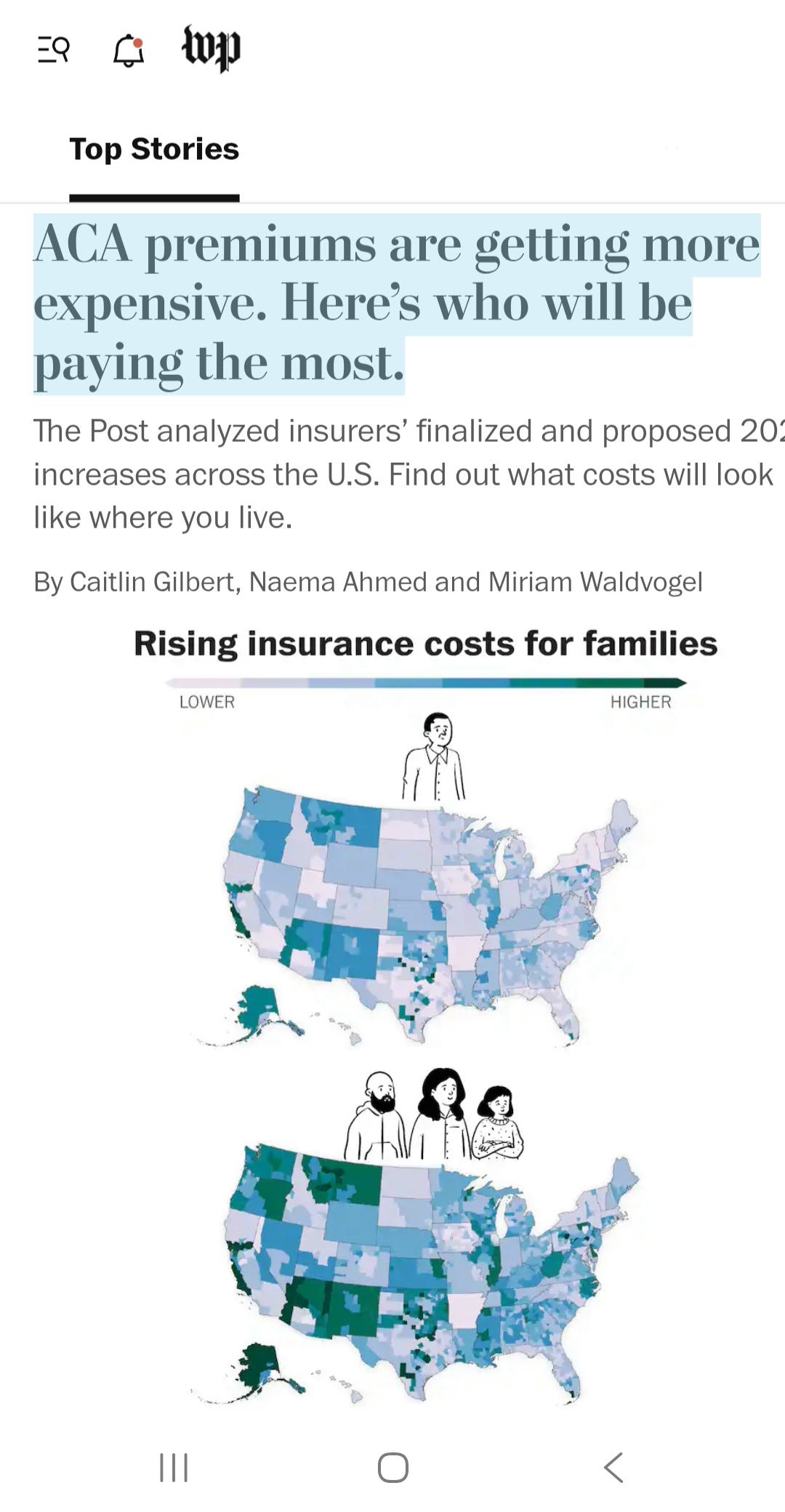
While some blue states will be hard hit—most notably, Washington, Oregon, and the already extremely poor state of New Mexico (which Trump has never exhibited any interest in other than to demand it change its name to “New America”)—the axe will fall hardest on lower-income rural (predominantly Republican) voters in red and purple states. These states include Alaska, Arizona, Kansas, Mississippi, Montana, North Carolina, Oklahoma, and West Virginia (six of which states—all but Oklahoma and West Virginia—have very competitive congressional and/or gubernatorial races on the ballot on November 3).
While blue areas on the Californian coast will also be hard hit—a fact Trump is sure to relish, based on his past statements of contempt for these Americans—to the extent blue states will be affected by Trump’s plot to destroy the ACA post-election it’s almost exclusively the red areas of those blue states that will suffer: e.g., downstate Illinois, rural Texas and Pennsylvania (the latter being more a purple state than a red state, of course) and upstate Wisconsin (likewise more a purple state than a red state).
While all this will be less of an issue for single-person households, it will eviscerate the families Trump, whose “movement” is radically pro-natalist, says he wants to encourage.
So why has all this suffering been pushed off beyond the midterms? Because nearly all Democrats oppose it—and are to be credited (along with the late John McCain, whose grave Trump often metaphorically spits on for this very reason) with developing and passing the ACA in the first instance—so Trump needed to be sure that the midterms were free from much discussion of the shiv he’s hiding behind his back…
…and planning to plunge into the back of every working-class voter post-midterms.
Then there’s Medicare and Social Security.
On this subject, Donald Trump isn’t just quiet about what’s coming in 2027 but lying systematically, as the New York Times reports (emphasis supplied):
Millions of people with private Medicare coverage are being forced to change their insurance for 2027 and will pay higher prices for prescriptions and medical care, prompting some experts to warn that more older Americans will face greater financial hardship.
Major insurers, like UnitedHealth, Centene and state Blue Cross plans, have shuttered plans that they viewed as unprofitable in certain markets, leaving some people with fewer choices of policies, and even more limited choices of doctors in 2027. In some rural counties from Oregon to New Hampshire, older Americans shopping for private Medicare Advantage plans will find that options have vanished completely or are dwindling to just a few plans.
Overall, as open enrollment begins this month, roughly five million people will be forced to switch plans because their current policy has been canceled or is no longer offered in the county where they live, according to an estimate from Duos, a health technology firm.
Dependent on Social Security and other fixed incomes, recipients also will be paying substantially more in out-of-pocket costs next year when they need a prescription drug or go to a doctor or hospital.
The upheaval and confusion in some areas of the country are in sharp contrast to the Trump administration’s claims that the Medicare Advantage program is “stable” and that average premiums will be lower next year.
Now that about 35 million older Americans are covered by Medicare’s private plans, many will face an enrollment period that is likely to be volatile, according to insurance brokers, industry analysts and experts.
The disruptions risk angering older voters before the midterm elections. Many voters say they are unable to afford increases in health care, groceries and gas. A KFF poll released this week found that nearly twice as many likely voters trust Democrats more than Republicans to handle health care costs.
President Trump has announced that the administration was sending out pre-election payments of at least $90 to 20 million traditional Medicare beneficiaries—but not those covered by private plans. Democrats called it a “desperate” move in the face of voter disapproval.
Proof quotes the above at such length to emphasize that this isn’t the typical situation of a major political party (say, the Republicans) hiding a post-election agenda that will hurt its opponents (say, the Democrats). Not wanting to help “GOTV” efforts for your political opponents is pretty standard fare in American politics. But this isn’t that.
First, Trump and his party have chosen insurance companies and the wealthy over their own voters. They’re betraying every demographic that leans red: rural voters, older voters, voters who prefer private insurance to public insurance, and the white working class and working poor.
Second, because Trump and his party know that they’ve betrayed their own voters, not merely failed to protect men and women who don’t tend to vote for them, they’re lying about what they’ve done—telling voters that prices are and will remain stable when their own internal analyses confirm that exactly the opposite is already (and will keep being) true. This helps to establish that Trump trying to keep Medicare off midterm voters’ radar is deliberate and nefarious, not incidental or merely negligent. Nor is it the only instance of Trump demanding his own voters disbelieve their own lying eyes.
Third, Trump is so aware that he’s betrayed his own voters, and is actively lying about that betrayal on the campaign trail—because, in essence, his and his party’s ruse has been caught out—that he’s now attempting bribe voters (but only gesturally, and not the ones who’ll be hardest hit) to obscure what now seems like a seven-layer shit-cake.
Again, we see here that this isn’t just U.S. domestic politics as usual. It’s a desperate, unprecedented betrayal of a party’s own voters that the party hasn’t and seemingly can’t explain—indeed one so inexplicable and idiosyncratic that it’s being papered over by bribes. For this reason alone, it looks more like congressional chicanery-cum-election interference than mere creative agenda-framing.
But of course the foreign policy component here changes even that dark assessment.
In fact, it establishes that Trump has so little interest in what happens after the 2026 midterms—almost like he doesn’t anticipate there’ll be further federal elections—that he’s hiding not just almost his entire domestic agenda but his entire foreign one, too.
As Donald Trump knows—for heaven’s sake, as the whole world now knows—his least popular policy item among his base, and across his entire domestic and foreign agenda, is his flagrant and deadly betrayal of his 2024 campaign promise to avoid “forever wars.”
So what is Trump trying to hide from midterm voters with respect to his foreign policy? Well, not just that he’s going to return to the categorically detested Iran War, but that he’s going to do so in ways so dangerous they could cause World War III.
Briefed in a classified setting on what Trump is planning, Sen. Chris Murphy (D-CT) emerged visibly rattled, calling the plan “insane,” “a devastating escalation [of violence],” and the “destruction of our commitment to the rule of law.” He strongly intimated that Trump and his sidekick Pete Hegseth will soon be dropping MOABs on civilians, which is not just a war crime that will make America a permanent rogue nation but could easily spark the sort of endtimes-like Christian-Muslim world war that Hegseth in particular appears to want (as evidenced by the ideological tradition he’s emerged from).
So Donald Trump is systematically hiding from voters what amounts to an anti-Republican economic-terror plot at home and possibly the end of America’s alliances and hope for global security abroad. Worst of all? No one knows why he’s doing it—just that he’s lying about it through his teeth, it almost exclusively benefits America’s enemies, and there’s no identified benefit for the American people on the other side of it… at least not any that an educated midterms voter would credit. Making it inevitable that China will invade Taiwan in 2027, without America having any spare capacity with which to intervene? That’s starting to seem like the best-case scenario, now. At worst, Russia could move forces into the Baltics as NATO, America-free, crumbles.
Yet because none of these traps have sprung yet, it’s (a) more difficult for candidates to get voters to pay attention to them—especially amidst all the other struggles this administration has heaped upon them—and (b) harder for major-media outlets to justify to their corporate editors and owners covering them, as the midterms are the bright and shiny object sitting before all of us, and the consequences of our votes can therefore be cynically relegated to second-class status by those with a sharp interest in doing so.
(63) As established by previous entries in this report series, Trump and his chief mega-donor Elon Musk have a particular financial and personal relationship with the 2026 Texas Senate race—indeed to the point that the candidate himself, an almost cartoonishly corrupt Ken Paxton, has privately opined that he isn’t even running his own campaign… but rather, the White House is. So whereas normally it would be quite unusual to blame a POTUS for an unprecedented strategic decision made by a Senate candidate who simply happens to be from his party, in this case we have the candidate himself to thank for the idea that his most unusual new campaign maneuvers are being orchestrated by the sitting presidential Administration. All of which makes what’s happening with Paxton’s campaign in Harris County stunning.
As the Houston Chronicle reports, the Trump-Paxton campaign appears to be trying to argue that the 2026 Texas Senate race must be deemed “invalid” after the fact if the Democratic Party is allowed to continue to...
... air local ads that target their core voting constituencies.
Lest you think that’s some sort of hyperbolic misstatement of what is going on, here’s the relevant Chronicle text itself:
[Ken Paxton’s Texas] Attorney General’s Office is suing Harris County, accusing county officials of targeting get-out-the-vote ads only to certain racial and ethnic groups ahead of next week’s midterm election.
The lawsuit comes as Harris County, a Democratic stronghold, has seen sky-high voter turnout. The attorney general’s office is led by Ken Paxton, the Republican U.S. Senate candidate at the top of the ticket. The Attorney General’s office said Paxton recused himself from the suit.
The lawsuit says the county is directing its ads on Meta platforms, including Facebook and Instagram, toward African-American, Asian, and South American or Latino groups.
“Ken Paxton filed this lawsuit in the final days of voting because he wants to stop Houstonians from going to the polls,” [Rep. Christian] Menefee (D-TX) said. “He’s whining about ads that do nothing more than tell neighbors when to vote and where to get information about voting.”
Harris County voters cast more than 860,000 ballots by Thursday, the second-to-last day of early voting in a hotly contested midterm where Democrats are trying to win statewide office for the first time in three decades. That was the most total votes recorded of any county in the state.
The Attorney General’s office is asking a judge to issue a temporary restraining order directing the county to stop running the ads it deems discriminatory. The office in a press release called the ads a “voter suppression scheme that could harm the integrity of Texas elections.”
There’s filing frivolous lawsuits days before a federal election, and then there’s this.
It smacks of war criminal Benjamin Netanyahu accusing Arab Israelis of trying to “steal” the recent Israeli presidential election… by voting. (Yes, really.)
As an attorney, all this author can say is, “What a mess.”
Keep in mind, as you read the above, that this suit was filed by the same political party that’s been advancing explicitly white-supremacist election appeals throughout 2026; the same political party whose leader increasingly uses AI to misleadingly fictionalize real-world events without making clear he’s doing so; and the same political party that brought America the idea that corporations are “people”… and therefore somehow have First Amendment rights. Yet apparently the Democratic Party doesn’t have a First Amendment right to air the political ads it wants—a bizarre and nakedly anti-constitutional view that’s now led Trump and Paxton to set up the most unusual plot to invalidate an election that’s ever been conceived… as they apparently plan to claim that a political party’s pre-election marketing campaign can violate an executive order (specifically, the one that claimed to eradicate DEI; never mind that it only did so—to the extent it could or did do so at all—within the federal government, and has no purchase among private entities like the Democratic Party). Once upon a time, the GOP was a party that recognized public-private distinctions. That’s no longer the case.
This is an opportune moment to remind readers that, given the near-certainty that Senator John Fetterman (D-PA) will switch over to the Republican Party after the midterms—and the fact that the Republicans currently hold a 53-47 advantage in that body—every single Senate race could be the difference between Democrats controlling both houses of Congress in 2027 and Democrats controlling one or none of them.
If the Democrats control both the Senate and the House, not only will they be able to impeach Donald Trump but also ensure that he’s tried in public in a televised event in which the nation sees all the evidence that he’s committed enumerated “high crimes and misdemeanors.” If you wonder why Trump has targeted the Texas Senate race as the race most likely to appeal to Democratic Party aspirations but also to disappoint the party—as it has for over thirty years in every such race—and if you wonder why Trump therefore sees the Texas Senate race as central not just to holding the Senate for Republicans but keeping hidden from the American people all the crimes he has committed since January 2025, well, wonder no further.
The stakes here also underscore why Trump and the White House would direct Ken Paxton to launch such a clearly frivolous civil suit. As we’ve already seen repeatedly throughout this report series, none of the Trump-ordered lawsuits filed with respect to the 2026 midterms are likely to be successful—no more than the 60 failed lawsuits he filed trying to overturn the results of the 2020 presidential election (in one of those suits he earned the right to have his polling-place observers in a single state stand a few feet closer to ballot-counters, but that was the only documented court victory he earned in November or December of 2020).
Rather, here—as with every other entry in this report series involving a civil lawsuit—it’s evident from the reports we’re getting from inside the FBI and the White House (see supra) about Todd Blanche planning an all-states post-midterms legal offensive, and Trump possibly planning a post-midterms invocation of the Insurrection Act, establish that all Trump wants for now is a massive litany of complaints he can later use to justify the unjustifiable: the end of American democracy.
Of course the Democratic Party has a right to run ads targeting its core constituencies, and of course the Republican Party up until just a few weeks ago would have said that ads of this sort are not only permissible but exactly the sort of targeting the GOP has proudly done over the last 70 years (when in fact it hasn’t, during that time, actually been targeting discrete voter demographics but rather seeking to incite racial, ethnic, and religious hatreds to the largest degree possible wherever it may encounter them).
But can Donald Trump claim after the fact that an executive order he issued in 2025 was in some way violated by the Texas Democratic Party and the Talerico campaign, and that this question isn’t just legally colorable but a matter for the GOP-led Texas State Legislature—and only that partisan body—to decide pre-certification? And then, on that basis, insist that his far-right allies in the Texas State Legislature have every right to overturn the will of the people and the results of the 2026 Texas Senate race? No, he can’t.
Or, rather, no he can’t—if the question is whether it would be ethical, moral, legal, constitutional, responsible, or consistent with his Oath of Office to do so. But as none of those concerns have ever seemed to concern Donald J. Trump, the answer is “yes.”
(64) This is the first federal election taking place in the shadow of an election-rigging perfect storm: the advent of betting sites that let users bet on political outcomes (even as they’re not yet equipped to fully investigate whether political insiders are engaging in insider training). And guess what? The Trump Family is at the heart of all this; it’s Republicans who are being caught left and right rigging political events to make money on sites like Kalshi and Polymarket; and there’s real reason to fear that much of what voters are now being exposed to is actually an illegal backroom betting scam.
First, the basics:
- President Trump’s heir and eldest son—who also happens to be polling third in the 2028 Republican presidential primaries and is the Trump Family member most likely to take the mantle of MAGA leader from his father over the next 48 months—owns a significant financial stake in Kalshi;
- Don Jr. also owns a significant financial stake in Polymarket;
- he’s identified as an “adviser” by both political-betting entities;
- President Trump admits that Don Jr. has “inside information” that would be relevant to questions of significant political and business import (exactly the sort of questions that bets are traded on Kalshi and Polymarket daily with respect to);
- Don Jr. has for years had secret financial and personal and political linkages to America’s enemies, all of which he’s attempted to hide in an obvious sign of consciousness of guilt (see here, here, here, and here, though frankly the Proof Series as a whole contains hundreds of such data points);
- Don Jr.’s associates at at least one of the companies above are now facing the possibility of prison time; and
- the consistent pattern here is that it is mostly Republicans—including those close to the Trumps—who are the ones trying to rig political events to make money on betting websites.
This is an emerging phenomenon, so there’s only so much that can be said about it here. The question for the moment is not whether we know that the Trump Family is making millions and millions illicitly through political insider trading that appears to be tied to events the White House controls, but (a) whether such trading is happening (it is), (b) whether the Trump Family is capable of corruption of this sort (they sure are), and whether any American can be confident that the Trumps and their agents aren’t rigging certain political events to make money from betting sites (they cannot).
(65) Election-rigging schemes cost their opponents not just financial and human resources but time—and not just these and other forms of resources at the national and institutional levels, but at the local level as well. That Trump is attacking the United States’ election infrastructure like a frenzied murder-clown springing out from behind a stack of crates in a deep, dark, and dank basement means that the minute-yet-instant responses demanded from his political opponents must be just as nightmarishly kinetic. And since that’s basically impossible, we must add a sense of dread and despair to the toll of what’s happening now to the midterm elections.
In other words, this report series would be woefully remiss in itemizing the various election-rigging schemes Donald Trump has spent the last 21 months advancing in public and in secret if it didn’t also include, at least once, the following observation: the unprecedented cost to Democratic voters, volunteers, and operatives tasked with trying to counteract all this election ratfuckery is staggering—and therefore constitutes its own de facto election-rigging mechanism.
Presenting your political enemies with a low-level civil war to deal with in addition to the normal rigors of running a political campaign in the digital age is beyond cruel. It acts as a calculated pseudomilitary maneuver, whether it was conceived that way or not.
Trump’s opponents are faced with tactical, strategic, legal, logistical, financial, and resource challenges on the same order as those a military force faces during a military exercise. It is all too easy to call what is happening right now an assault on America, its way of life, and its vital infrastructure without accepting that the term assault is apt.
Trump and his agents have stolen from their Democratic political opponents—that is, all the institutional, personal, and pecuniary components comprising a political party and its tens of millions of adherents—tens of thousands of human hours and possibly tens of millions of dollars that shouldn’t have had to be expended in the first instance.
By way of example, Proof points to this recent exposé in The Bulwark, a conservative publication that acknowledges that Democrats and their supporters have had to take extraordinary measures just to try to ensure that the midterms will be conducted in a manner vaguely consistent with past American elections.
Democrats should not have had to—but have had to—build from scratch a veritable army of “democracy protectors” whose primary function is essentially to replace the international observers Trump has barred from the country; alleviate the coordinated harassment of local elections officials at polling places (to the extent doing so is legal, possible and feasible); and generally ensure that the midterms are approximately as free and fair as American elections were before Trump and Trumpism came on the scene.
This last point is especially salient now that Trump’s handpicked new DHS head, Markwayne Mullen, has strongly implied he thinks this election will be full of leftist shenanigans—which of course is a way for DHS to pre-justify further uncommon harassments and procedural deviations by itself or allied and sympathetic far-right actors… which developments will in turn will require, of course, still greater resource deployments by the Republicans’ political opponents.
After a recent address at CISA, an election cybersecurity agency Donald Trump gutted to make our elections more susceptible to foreign inference (yes, that indeed appears to have been the primary focus of his supposed “reforms”), one CISA attendee said, per Politico, that “it was like a Rorschach test: Mullin said ‘just enough’ to signal support for Trump’s election agenda, but left things ‘vague’ enough to avoid legal challenges [to DHS plans for the midterms].”
Here—below—is what Secretary Mullin has said specifically, as summarized by CNN.
(If it all sounds to you like an invitation to Election Day madness, rather than an attempt to ensure that the midterms run as smoothly as the election CISA certified as historically free and fair in 2020—before Trump punished it for that determination with planned obsolescence—you’re right. Emphases are supplied in the excerpt below.)
In July, Mullin claimed DHS had identified more than 250,000 noncitizens registered to vote in California, Pennsylvania, New Jersey and Nevada by analyzing public voter lists as well as roughly 25,000 noncitizen registrants in more than a dozen Republican-led states that voluntarily handed over their rolls.
But the headline-grabbing numbers Mullin presented as “fact” have come under immense scrutiny and, in some cases, failed to hold up.
Even some Republican officials have warned that the DHS findings are misleading and dramatically inflated.
Mullin has echoed Trump’s longstanding warnings that most voting machines are vulnerable to hacking, particularly because they contain foreign-made parts.
“We know that [foreign adversaries] can change voter registration and your vote,” Mullin said in July.
In fact, there’s zero evidence that foreign hackers are able to—or ever have—changed Americans’ votes, so a Cabinet-level official baldly stating otherwise can only be seen as a prelude to extraordinary future “enforcement” actions undergirded by rhetoric rather than hard evidence. And down that road lies the collapse of our democracy.
(66) So what has Donald Trump actually had CISA—or what remains of it—do instead of preparing America to fend off foreseeable foreign cyberattacks during the midterms? He’s demanded that they secretly hack a voting machine and change the votes on it so he can use that “finding” to justify making exactly the opposite claim about America’s elections from the one CISA made in 2020. In short, Trump wants to declare our entire democracy semi-permanently unsafe and categorically invalid.
Nor need we wonder where such a declaration by CISA would take the country. No more than we need to wonder what Trump was hoping a December 2020 letter from interim Attorney General Jeffrey Clark to the Georgia State Legislature falsely claiming that the 2020 presidential election had potentially been interfered with would result in: the eventual overturning of the election results by partisan actors.
This is what the same gambit looked like in early December 2020, in headline form:
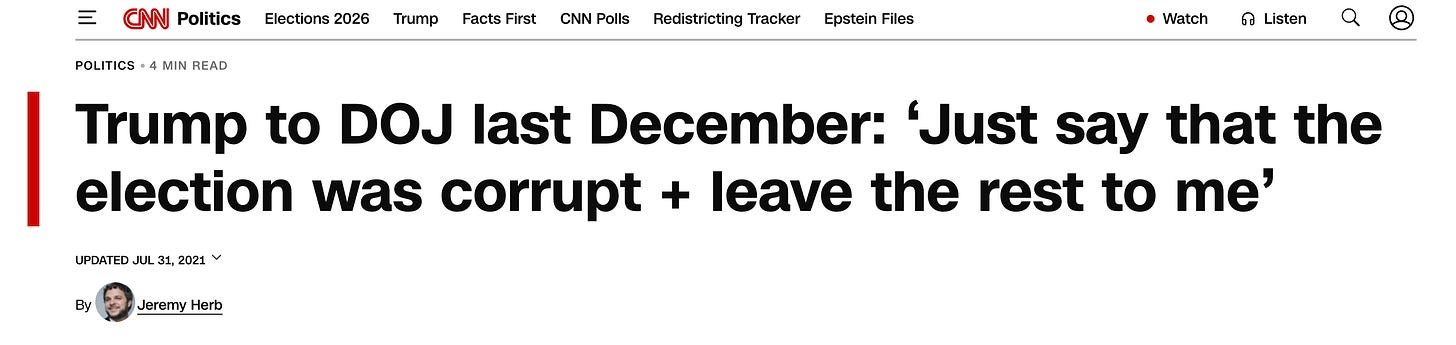
The full quote is even more instructive: “Just say that the election was corrupt and leave the rest to me and the Republican Congressmen.”
If Trump can get CISA to declare that U.S. voting machines are not just hackable but susceptible to after-the-fact (post-election, not in situ) vote-switching—which they’re not, though given that the Secretary that runs CISA (Mullin) has already falsely said they are, it shouldn’t be too hard to find some unscrupulous CISA employee desperate to keep their job and willing to say so—he’ll presumably say the same thing to CISA that he previously said (with less success) to an older, generally more reputable federal unit, DOJ: “Just say that the election was corrupt [because the voting machines were vulnerable to compromise] and leave the rest to me and the Republican Congressmen.”
Trump made clear in 2020—and is making clear with his actions now—that he thinks the midterm results can and will be determined not by judges or even voters but by the branch of the federal government he controls, along with any legislative body, state or federal, that his party still holds power over.
(Elon Musk, his political copilot, made clear in a recent Twitter rant that even if the House is lost, “51” GOP votes in the Senate makes all things possible. Trump clearly has the same belief—and the same apparent willingness to do anything to get there.)
(67) To no one’s surprise, the disabling of CISA’s anti-foreign election interference capabilities has led to a resurgence in digital election interference by Trump’s supporters—now war partners—in the Kremlin. This resurgence has manifested with particular force in the election Trump himself is most intimately, personally involved in: the one in Texas.
There’s a reason conservative New York Times columnist Bret Stephens said in an interview recently that “a candidate like Paxton isn’t just a Trump surrogate. He’s a Trump stunt double.”
Paxton is little more than a Trump proxy at this point, again by the candidate’s own recent admission (a private audio recording captured Paxton saying to supporters in private, “It’s all coming from D.C.—I don’t control message or what we’re doing”).
So it matters that, as leading Texas politics publication The Texas Observer reports,
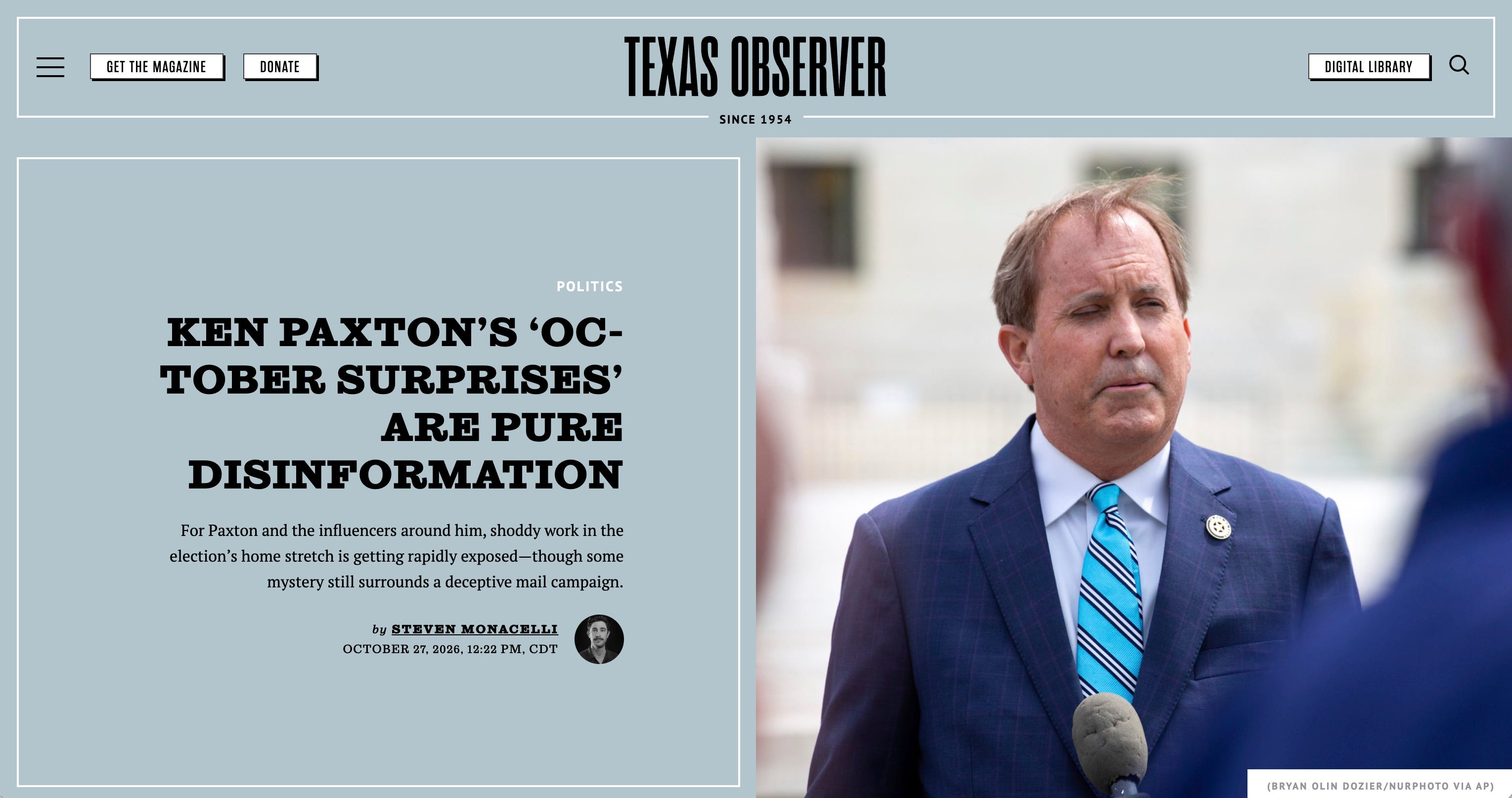
Pretty striking, no? That the people in the White House who are secretly running Mr. Paxton’s campaign saved up certain allegations to act as a would-be game-changing “October surprise”—meaning that they had ample time to confirm or deny their accuracy pre-publication—and it still turned out they were all “pure disinformation”?
So what do we do with the fact that they also appear to have originated in Russia?
(68) Elon Musk is a former pseudo-Cabinet-level second Trump administration official; he’s the largest Trump mega-donor by an order of magnitude (and the largest donor to any American political party by an order of magnitude); he’s a current Trump adviser; he’s a government contractor who works daily with the Trump administration; he’s in regular backchannel contact with Trump by phone, and fears that he’ll “go to prison” the moment Trump isn’t in power; he’s without question the most important mouthpiece for Trump policies outside the president himself; and, as of a few days ago, he’s confirmed to be working directly with Trump on the most serious foreign policy matters facing the United States—including matters of war and peace. So it long ago ceased to be a credible argument to say that Musk isn’t a Trump agent. Consequently, Musk moving into the Orwellian field of “election integrity”—code for a brand of far-right authoritarianism that aims to end free and fair elections in the United States—as he slowly approaches one billion in GOP-only donations to the 2026 midterm elections cycle, must be attributed either Trump’s explicit permission that he do so or, more likely, his active encouragement.
It’s with this in mind that Wired now informs us that a law firm linked to Musk has started an “election integrity” operation.
There’s simply no other way to frame the significance of this news: it means that the richest human ever to live will be personally financing the post-midterms effort to end America’s democracy. And as someone who worked in America’s legal system for about a decade, I can tell you that the system is not built to withstand the influx of that amount of money. It structurally cannot withstand a trillionaire who’s trying to avoid prison—let alone one back by the President of the United States, the United States Armed Forces, DOJ, the FBI, DHS, ICE, many state legislatures, and possibly (if Trump, Musk, and Sen. Fetterman get their way) at least the United States Senate.
(69) The President of the United States works for the American people, and takes an Oath of Office to act like it. He lives in a mansion we pay for and—as the American Revolution conclusively established—he has only the power we consent as a people to grant him. Whereas a politician not in public office can do as he or she likes when asked a question by First Amendment-protected reporters, there’s long been an expectation that a POTUS asked a question by a bona fide journalist—especially in an election cycle—will choose one of three options: (i) answer it honestly, (ii) answer it dishonestly, or (iii) refuse to respond at all. Any of the three gives voters much-needed data: either accurate actionable intelligence (first scenario); a revelation about the dishonesty of an elected official (second scenario); or some sense that an existing restriction is in play with respect to a given topic (for instance, the inability of elected officials to discuss classified topics in unclassified settings*) or that a topic requires more media investigation. So yes, it’s historically unprecedented, and worth documenting as an attempt to make American elections less free and fair, that a man whose salary and housing we pay for—and whose various slush funds are comprised almost entirely of our money—now routinely chooses a fifth option in response to queries from the free press: insulting the questioner, and using the very nature of their employment as an excuse to structurally avoid accountability.
*With all the above said, admittedly Trump has a little less leeway in this third scenario, having strongly emphasized to American voters that he can declassify intel with his mind.
If this were a one-off situation, it wouldn’t be mentioned here. Every president has the right to occasionally blow off steam by insulting a particularly aggressive journalist.
But that’s not what’s happening here.
Trump is systematically evading oversight by the free press by viciously attacking journalists on camera and selectively deciding which media outlets can have access to him as a public servant.
And it’s not just him tossing CNN, MSNow, and Politico out of the White House, either, or following up on particular run-ins with individual journalists by throwing them out of a building (or a plane on the tarmac) he doesn’t own. It’s in fact a pattern of abuse that is getting much, much worse.
Recently, a Reuters journalist had the temerity to simply ask Trump if he had cancelled planned rallies in Kansas and Iowa because he was sick of traveling.
Trump’s response? Over twenty seconds he called the reporter “sick” three times, and “disgusting,” and said he was “out of shape” and “looked like hell” and was in “bad” condition.
Then his aides, including his morbidly obese spokesman Steven Cheung, began trolling the reporter online under photos of him and his wife eating food on vacation.
And guess what? Trump misheard the question, thinking the journalist had asked him if he personally was sick. So all that abuse, bile, and even stalking was over Trump’s bad hearing.
At what point do we accept that a President of the United States acting with open aggression during an election cycle in a way no other POTUS ever has constitutes an out-of-bounds form of election-coverage tampering?
(70) There were Hatch Act violations before Trump entered American politics, of course, and there was, too, a time during the first Trump Administration when Hatch Act violations became semi-common but were still a violation of federal law that Trumpist violators felt sheepish about (at least enough not to be cavalier about them, e.g., by discussing such violations openly with the press or acknowledging them under oath). While former Trump campaign manager Kellyanne Conway broke the first seal on this state of affairs by infamously saying she didn’t care about the Act, it wasn’t until the second Trump administration that the Act was systematically destroyed by tacit executive fiat. The Act has now been illegally, unconstitutionally, and unilaterally ended by an executive branch that has no authority to do so—with the result that not only is Trump’s personal lawyer (and nominal Attorney General) Todd Blanche claiming to have authority to bless Act violations—which he could always do implicitly, simply by never prosecuting them, but certainly couldn’t do under color of law—but it’s clear the Trump political machine has made violating the Act essential to its election-rigging strategy.
Here’s coverage of the demise of the Hatch Act—a highly consequential new election-rigging strategy for Team Trump.